


























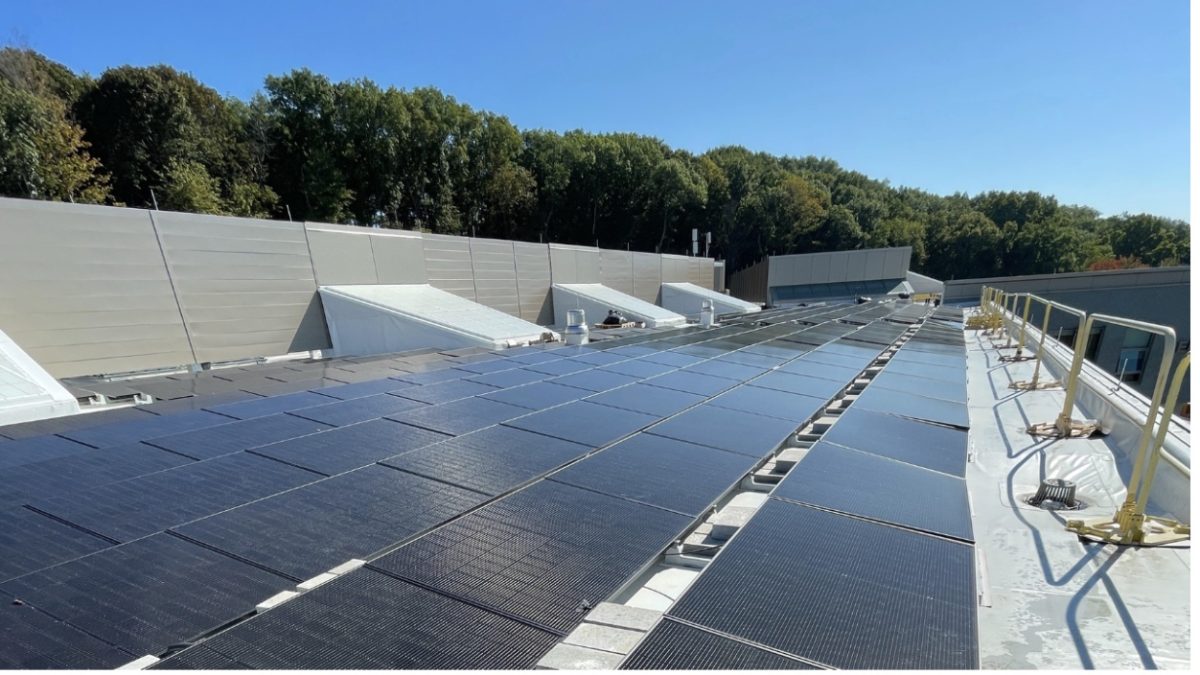



Renewable energy, a term previously confined to the science classroom, has become a reality for Foster Elementary School, as 233 rooftop solar panels were added to its power grid this past fall. In order to reach Hingham’s ‘net zero’ carbon emissions goal by 2040, the Hingham Public School District has been taking impactful strides, most recently in the construction of Foster Elementary School.
After its construction was completed last January, the School Building Committee was able to deliver on its promise of an all-electric building that met the needs of Hingham’s ‘sustainable development goals’. To meet these goals, the design of the building included a ‘solar-ready roof’ that would be able to maximize sunlight exposure(Source). Between then and this fall, 233 rooftop solar panels and 2 inverters were installed and added to the power grid, providing power for the school.
Foster Elementary School’s adoption of solar panels has coincided with a state-wide trend, as 181 schools have installed solar systems, according to the SEIA, with more expected to come along in the coming years. Although states such as California and New Jersey still dominate the country in solar panel usage for K-12, as they account for more than 50% of all installations(GT), Massachusetts has been making an effort to promote the use of renewable energy in schools.
There are many reasons why school districts should consider solar as a viable option for energy. The most immediate effect that would be felt from the switch to solar energy would be the financial impact. Many schools in the Boston area are predicted to earn sizeable returns on their investments, as Rhone Resch, the president of the Solar Energy Industries Association, states,” Worcester and Springfield could each save nearly $2 million and Brockton about $1.5 million.” He goes on to explain,”In a time of tight budgets and rising costs, solar can be the difference between hiring new teachers or laying them off.”
These financial incentives are not all speculative, as schools across the nation have experienced sharp declines in electricity bills, some cut in half compared to the bills before the installation of solar panels. In addition, many government programs offer financial incentives to school districts choosing renewable energy.
The greater long-term effect of adopting solar power in schools is the environmental impact. As explained by David Masur and Tony Dutzik in their article about solar panels on schools in Pennsylvania, the solar power generated by all schools in Pennsylvania over their solar panels’ lifespans will equate to cutting the carbon dioxide emissions of 300,000 cars on the road. These staggering statistics are just a glimpse into how impactful solar energy in schools could be for the future of not only their communities but the planet.
Rex Chen, a sophomore at Hingham High School, sums up the environmental benefits by stating,”Solar panels are a great addition to our school district because they lower fossil fuel emissions and provide renewable energy.”
Foster Elementary School’s new solar panels are not only a great addition to the power grid in the present day, but hopefully are a sign of what is to come in the future regarding a trend towards renewable energy sources.
Spencer Farish, a sophomore at Hingham High School, states,“I would love to see more solar panels in our community because it solves an issue we have with the promise of cleaner energy; most energy sources are still not clean. We have the infrastructure and technology to support a cleaner world, especially with electric cars, so adding more clean energy to the grid allows for constant improvement of our environmental footprint, where products that use nonrenewable sources cannot.”