
























As midyear exams rapidly approach, sleep deprivation, lack of motivation, and an overall low energy level tantalize many Hingham High School students. These exams count for either 5% or 11% of the final grade in a non-AP and AP class, respectively. On top of all of this, the antiquated HHS schedule prevents students from learning most effectively.
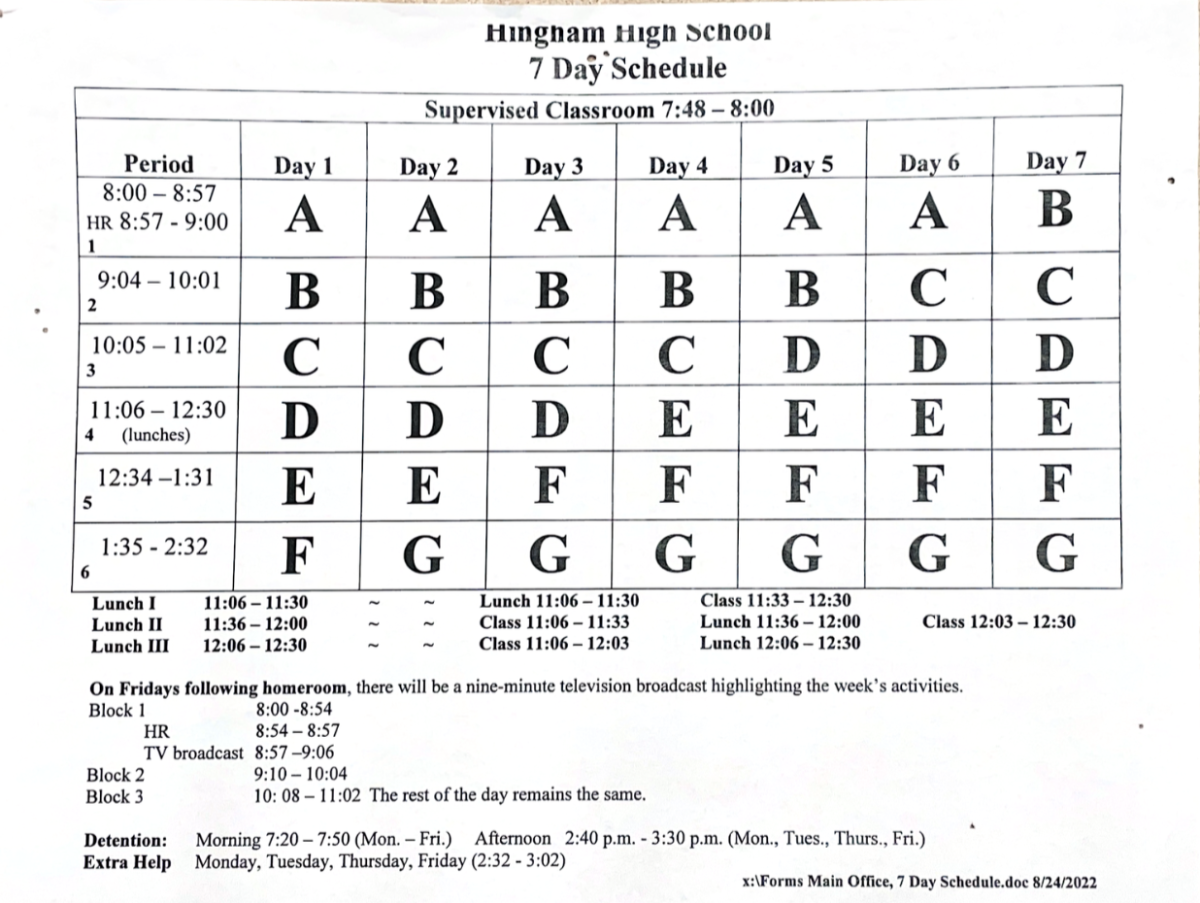
The HHS class schedule is as follows: six out of a student’s seven classes meet every day, each for 57 minutes. Classes “drop” — do not meet — in reverse order, so Day 1 skips G-block, Day 5 skips C-block, etc. The classes of the day always progress in alphabetical order; A-block is always at 8 AM, for example, unless it is Day 7, on which A-block drops. While this sounds complicated in concept, the schedule comes naturally after a few weeks, as knowing which class drops allows one to know the entire day’s schedule.
Although this schedule has a tenured run for over a decade, it creates imbalanced learning compared to a rotating schedule, which would allow each class to meet at varying times of the day.
Limited sleep means that students often struggle to focus during A-block which always meets at 8 AM. This leaves many students with one of two options: either do their best to naturally stay focused or drink coffee, or worse, an energy drink such as Monster or Celsius. While most students are aware of the negative effects of these highly-caffeinated drinks, the caffeine helps them focus through the early morning. Additionally, I often have difficulty completing homework for my A-block class, since by the time of completion, more than twelve hours have often passed since I learned the material. In addition, the repetitive routine of the HHS schedule allows students to more easily space out as their bodies walk through the day on autopilot. Senior Dylan Vale commented that “I sometimes have a tough time during A-block if I’m tired since I don’t drink coffee. It would be nice to not always have that class so early.”
However, this routine is also what makes the schedule appealing for some. Senior Zak Robbins says “I don’t think that a rotating schedule would improve and balance learning because the current schedule keeps me in a steady rhythm where I know exactly how my day will start and end.” The current schedule allows for certain classes to signify certain times of the day, such as lunch time or the end of the school day. These checkpoints can break up the daunting day into more manageable chunks.
How might the schedule change? I have grappled with this question for a while, talking to students at other high schools and researching past Hingham schedules. I believe the most effective and feasible modification would be to maintain six classes per day, but instead institute a rotating schedule, meaning the class that did not meet the previous day would start the next day. For example, if Day 1 is blocks A-F, Day 2 would start with G block and then A-E, Day 3 would be F, G, A-D, etc.
This schedule would change which class meets at 8 AM each day and would discourage students from going on “autopilot,” since they would need to consciously think about where to go next. According to a study from the National Institutes of Health, adolescents are consistently less attentive and have a higher resting state during their morning classes. In a town that advertises a thorough education in all subjects, the schedule creates a blatantly imbalanced learning experience.
According to Jayne Skinner, HHS’s Administrative Assistant to the Principal, the current schedule has been in use since the 2003-4 school year, the same year that the start of the school day moved from 7:20 to 8:00. In the past two decades since the change, technology and new learning resources have revolutionized the learning experience, meaning the then most effective schedule is no longer the most effective today.
While I will not see any potential changes during my time at HHS, it has the potential to revolutionize learning for future students of Hingham High School.