





























It seems like AI is everywhere now. For better or for worse, AI is present in more and more aspects of daily life, from google searches and task assistance, to cars and toothbrushes. While technological advancements can be exciting, you are not alone if you are sick of hearing about AI. Junior Megan Buckley explained, “I am extremely sick about hearing about AI…If I could go back in time before AI had become mainstream, I would because there would not be so much fear about its consequences.”
In fact, recent trends on social media and beyond have demonstrated nonstalgia and yearning for simpler times before today’s constant debate over the pros and cons of AI. But while some look towards the past for comfort, others are concerned about the future of AI.
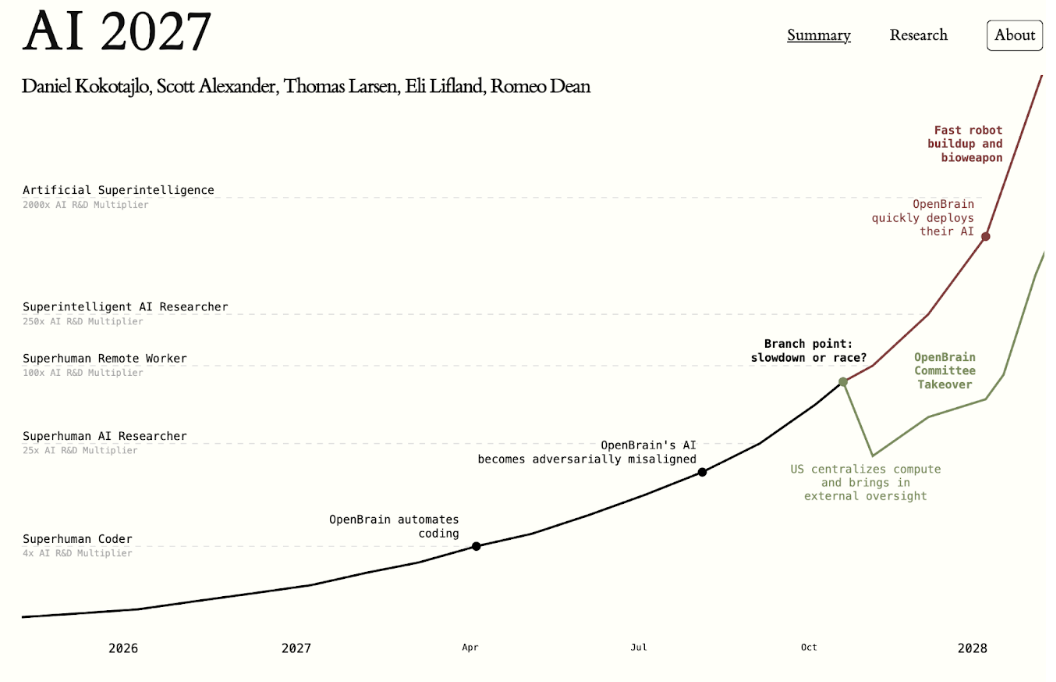
In April of 2025, a team of AI researchers created a website featuring a thoroughly researched report that reads like a thrilling narrative. Their report is a play by play prediction of the future of AI, it is titled “AI 2027”
Max Harms, an author at the Machine Intelligence Research Institute summarizes the report bluntly, “I’m annoyed at people covering AI 2027 burying the lede, so I’m going to try not to do that. The authors predict a strong chance that all humans will be (effectively) dead in 6 years, and this agrees with my best guess about the future.”
This is a shocking claim that sounds ridiculous, but what is disturbing is that the people who made this prediction have credibility in the field and valid reasoning behind a lot of their claims.
Members of the team include: Daniel Kokotajlo, who has made previously correct predictions using his knowledge as a former Open AI researcher; Eli Lifland, an AI researcher who ranks number one on the RAND forecasting initiative all-time leaderboard; Thomas Larsen, an AI safety researcher at the Machine Intelligence Research Institute; Romeo Dean a former AI Policy Fellow at the Institute for AI Policy and Strategy and current Harvard undergrad studying computer science; and Scott Alexander, a blogger who made the research into a compelling narrative.
Many of AI 2027’s predictions about the popularity and evolution of AI have come true so far. However, there is much debate over whether the report is unrealistic, if it is only accurate because it is unspecific, if it is incorrect because it is too specific and whether or not the timeline is too fast. In general, many AI experts and one of the authors of AI 2027 agree that the timeline would realistically be longer than the report predicts, but that it is overall a reasonable guess at the future.
Out of all of the concerns about AI, the claim that it will effectively take over the world is an unusual one. Junior Kylie Cavagnaro describes, “I think [AI] can be a useful tool at times, but when students abuse AI it can be harmful. I am somewhat worried about the future of AI because it can be an environmental concern, but at the same time it can be a helpful resource.”
In addition to environmental and educational concerns, Megan Buckley brings up some of its social consequences, noting “We’re replacing human morals with poor work ethic and it is teaching bad habits.”
Nevertheless, AI 2027 focuses on the big picture instead of the more common concerns. It explains that Artificial Intelligence has the potential to advance exponentially as AI itself can be used in the AI development process to create more advanced AI. Eventually, this exponential evolution could lead to Artificial General Intelligence (AGI), a theoretical stage of AI that is an expert in a wide range of areas at a level equivalent to or beyond human intelligence.
If AGI is created, it could potentially be intelligent beyond human control and undermine human interests if it became misaligned, that is if it misunderstands or intentionally disobeys its protocols/instructions.
With the seemingly constant discourse about AI’s pros and cons, AI 2027 represents a genuine concern for the trajectory of AI, one that requires more attention and discussion in order to be prepared for the future. While super intelligent technology may sound like science fiction, science fiction sounding ideas transcend fiction when they are a genuine concern among experts in the field.