















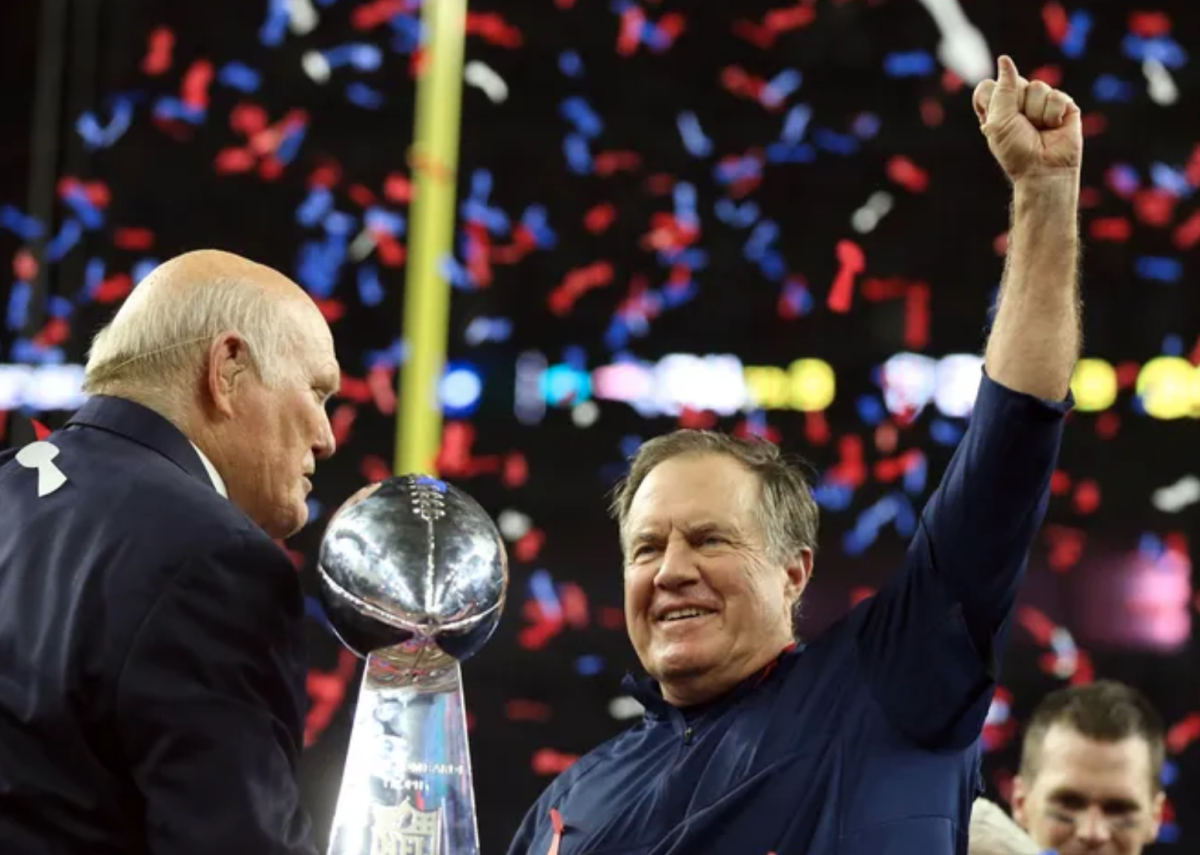
When news broke that Bill Belichick was not elected as a first ballot Pro Football Hall of Famer, the reaction across that sports world was immediate shock.
Belichick is widely considered as one of the greatest if not the greatest coach in NFL history, so many fans assumed his induction would be automatic. Instead, his absence from the first ballot has sparked major debate about the Hall of Fame voting process and whether outside factors influenced the decision.
Belichick’s resume is almost unmatched. He won six Super Bowls as head coach of the New England Patriots and two more as defensive coordinator with the New York Giants. He holds the record for most playoff wins by a head coach and is third in all-time regular season wins. Over two decades, the teams he led were known for their adaptability. Belichick famously tailored game plans to exploit the weaknesses and limit the strengths of the opponent. Whether this meant locking down a star wide receiver with double coverage or using situational football, Belichick’s coaching completely reformed the NFL in how teams strategize and prepare for upcoming games in this era of football.
So why was he not voted in immediately? One explanation lies in how the Hall of Fame voting system works. The selection committee is made up of 50 voters, mostly media members. In order to be inducted, a candidate must have at least 40 votes. Voters are not required to explain their choice on who they voted for, which leaves room for personal bias, individual interpretation, and subjective standards. Some voters have admitted in the past that they purposefully withhold votes, either to help other candidates, or to make a point about the process itself.
Many speculate that controversies from Belichick’s career influenced voters. Incidents like Spygate and Deflategate still overshadow his legacy, even years later. Spygate involved the Patriots being penalized in 2007 for illegally videotaping opposing coaches’ defensive signals, while Deflategate centered around the allegations that footballs were underinflated during the 2014 AFC Championship game. While Belichick was never suspended for Deflategate, some critics believe those scandals created enough doubt for voters to delay his induction rather than permanently exclude him from the Hall of Fame.
“I think people are letting the scandals shift their attention from Belichick’s achievements to questioning the legitimacy of his success,” said sophomore Nick Carrano. “Every great coach has some controversy, but not every coach wins eight Super Bowls.”
Others believe the issue feels more personal and emotional than procedural. “It feels like the voters wanted to make a statement instead of doing their job, which is honoring greatness,” said sophomore Sam Whitrap. “If someone like Bill Belichick is not first ballot, then who is?”
The reaction from players and analysts have been just as strong. Several have criticized the decision by pointing out that controversial figures, such as former Bills running back O.J. Simpson, remains in the Hall of Fame despite serious off-the-field accusations, exposing what they see as an inconsistency in the voting standards.
Whether Belichick gets in next year or later, the conversation surrounding his snub has exposed flaws in the Hall of Fame voting process. For many fans, the bigger question is no longer when Belichick will be inducted, but whether the system truly rewards greatness over objective opinion.