
























Every winter roughly one hundred schools across Massachusetts participate in the Massachusetts Educational Theater Guild (METG) Festival. The Hingham High School is facing off against Duxbury, Middleborough, Mansfield, and Franklin high schools and Cambridge Rindge and Latin School and Westford Academy on Sunday.
METG Festival, or “festie” as it is called by many drama students, was pushed from Saturday to Sunday because of the snow days caused by the blizzard that struck Massachusetts. The school’s on-cite rehearsal in Middleborough was moved from Monday to Saturday as well.
During festie, the actors, crews, and directors, as well as a panel of judges, watch all seven one act plays. After the last play has concluded, the students mingle and have pizza at an after party as the judges deliberate. The judges choose three of the seven plays to send to the semifinals and announce them in a closing ceremony in which they also give out various awards.
The Hingham Drama Club is performing Mr. Flannery’s Ocean by Lewis John Carlino with guest director Shayan Sobhian. The play is set around the late fifties or early sixties in coastal England and centers around 79-year-old Jim Flannery, played by Izzy Donnelly, who claims that he owns the whole ocean. His surly attitude causes him to conflict with the other characters, but after meeting Mrs. Pringle, a frail old woman with three months left to live, played by Allie Banks, he has a change of heart and decides to give the ocean to her.
Annie Daly, one of the prop crew head and the actress portraying Mrs. Klappington, detailed, “It’s been a really fun show. I liked putting the props together and just seeing it play out.”
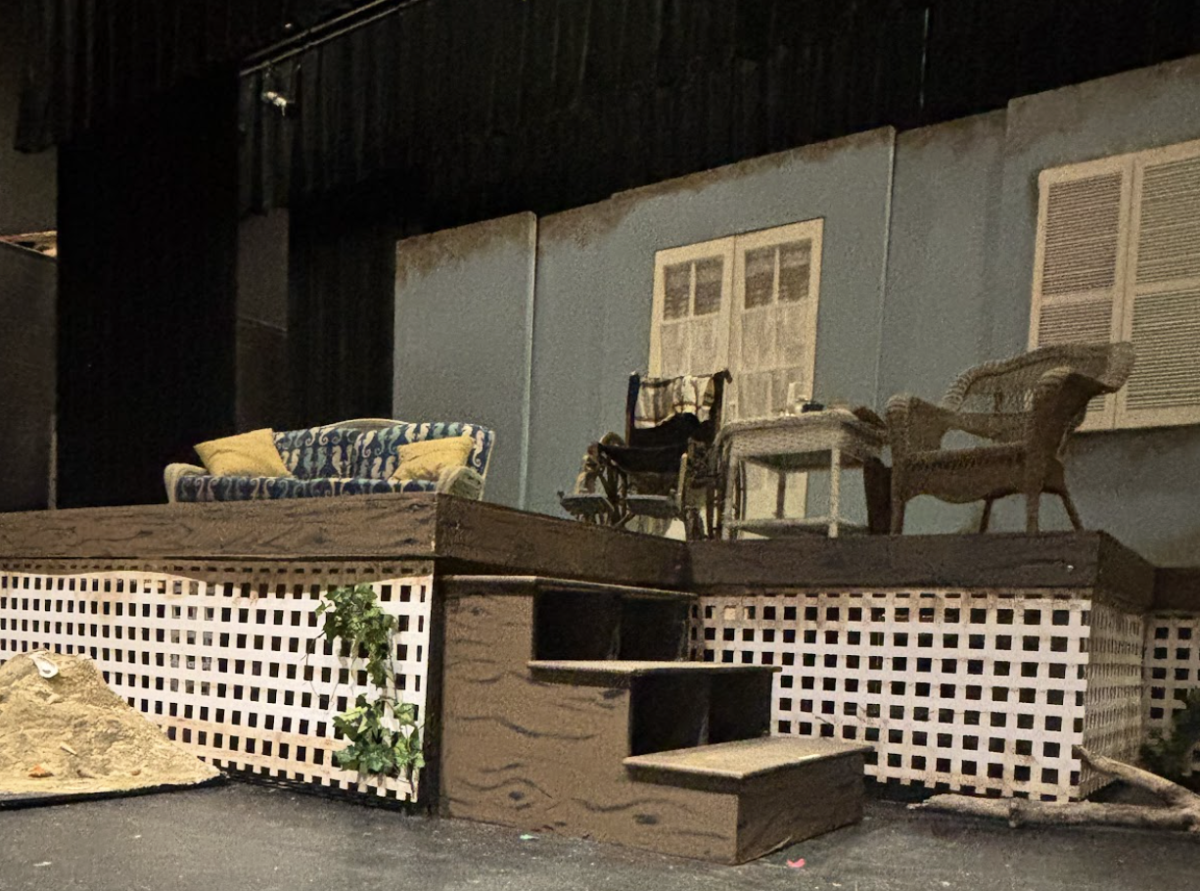
Aliyah Blidner added, “I’m an actor and in costume and set up crew, but personally I think the set looks really good.”
Mr. Sobhian chose this play for a handful of reasons, one being that it is meant to be a one act play that stays under the forty minute limit rather than a longer play that has been compressed. This decision gives the play a more natural feel, letting the slower moments play out instead rushing from scene to scene.
While the pacing is important, his main goal was to give the actors a chance to bring a story to reality. Mr. Sobhian states, “In some ways, the play works by accumulation. Its power lies in the presence of many small details. An acting teacher once told me: reality is incredibly specific; plays are not. You have to supply the reality. What time is it? What’s the temperature? Where are we? Where am I coming from? Where am I going? How old am I? Who am I speaking to? Do I like them? What am I trying to make them feel? Why am I saying this now? What am I thinking as I listen? When exactly do I decide to do what I do?”
“I don’t come from an acting tradition that sacrifices clear choices in the name of something that feels ‘freer,’ ‘spontaneous, or — heaven forbid — ‘natural.’ Acting is doing. Actors shouldn’t be asked to generate a performance out of thin air each night. The craft lies in making the premeditated appear spontaneous: complete spontaneity, precise repeatability.”
The characters in this play allow just that, characters that require their actors to breathe life into them and make each subtle choice add up to a compelling arc and overall story.