
























The words of Martin Luther King Jr., in an article for Morehouse College, are, “We must remember that intelligence is not enough. Intelligence plus character—that is the goal of true education. The complete education gives one not only power of concentration, but worthy objectives upon which to concentrate.”
This quote indirectly supports the idea that finding an education and college that suits a person can give them the chance for a complete education and a bright future. If a college does not challenge a person and cultivate their personality and character, it may not be the right fit. Subjects and environments that do not promote concentration, curiosity and learning, rarely gives a person motivation to continue with their field. These are only some reasons why it is important to find a college that suits the mentality and wants of an individual, if that is the path they choose to take.
As the end of the year nears closer, juniors, seniors and disinterested siblings travel around the country, and maybe even farther, to look at colleges. In a common time of excitement and significance, there is also an abundance of new information that not all people know or are able to retain. After conversing with people in junior year and higher, it is evident that many wish they had more knowledge or advice before their college tours and high school years.
1. Keep a notebook
Many people try to visit a variety of colleges to try and narrow down their options. Sometimes the specific details seen or heard about on tours, can be the deciding factors of a person’s future college. The size, student body, housing, food, financial aid and culture are only a few of the many aspects that vary colleges from one another but also they can be factors that blur colleges together in a person’s memory. These details can easily be forgotten over time, so it is important to keep some kind of documentation of both the pros and cons of certain colleges. Also, ranking the colleges can be beneficial because, even if you don’t remember the entire tour, you will know which colleges you liked and didn’t in the moment and can do further research.
Usually, tours will take place over junior and senior year, but for some, they take them earlier for reasons like being a younger sibling or convenience. For these people, it is even more vital for them to document their preferences and observations to help narrow down their options for colleges later on.
2. Take guided tours as well as walking around
Many colleges offer guided tours that many take over breaks like February, April and the summer, along with weekends. These tours usually consist of an information session that is run by current students and someone who works in admission to cover topics like student life, academics, study abroad programs, admissions and financial aid.
Afterwards, there is a group of tour guides that introduce themselves, their hobbies and major. Larger tours will split the groups up based on where people are sitting, while smaller ones let people choose their own tour guides. If you are in a smaller tour, or one that allows choice, it is important to listen to the majors and hobbies of a person because if it aligns with what you want to do, they will give you the most information and have the most knowledge about what you find important. I have been an eye witness to a tour guide that had the exact same major and path for the future, as well as similar hobbies, to someone who was on the tour, and helped sway them in the direction of the college.
During the tour, there are usually stops in or near academic buildings, libraries, labs, housing, cafeterias and transportation, so a majority of questions will be answered there. If they are not, tour guides will often happily answer some questions not having to do with the stop. Depending on the school, you will sometimes be able to see as much as the inside of a dorm and cafeteria, but, during some, you don’t even get to go into multiple buildings.
If visiting a college does not align with your abilities, there are virtual tours available for a lot of colleges that help a person get the layout and some information about the colleges. While the trustworthiness of the website in general is not checked, in a website called CampusTours a college can be searched and the website will bring the person to valid websites of the school, where they can find virtual tours, maps and videos, if they are available.
Guided tours are very informative and interesting, if you are at the right school, but exploring the campus without a guide can be favorable. You can try to find buildings that pertain more to whatever major you choose and sometimes dining halls are open to the public, so you can get an idea what some of the food is like. It can also be helpful if you want to know things like, how long it takes to get from one side of the campus to another, how many people walk around at a time after classes ends and how people interact with friends and acquaintances in passing.
3. Try to find fields that interest you
Knowing what field you are trying to go into in the future is not vital but it is useful, because if the school doesn’t have any majors that interest you, it isn’t the right fit and can save you some time. When asked about how she navigated the college search, senior Livie Correnti said, “I looked at the programs within the school that I was going into. I’m going into business, so I looked at the ranking of the business school, as well as the programs within. I learned a lot on the tours, so all I had to do was narrow my options down based on the business school.”
Sometimes, going online and searching for what schools have a program for the major you are interested in is the start of making a list of colleges to consider. It doesn’t even need to be a specific major, but if you find a field, like business, that is a large step closer to making a decision. There are around 2,000 majors offered in the United States stated by Lumen Learning in an informative article about majors, advice for choosing one and a real person’s experience with being indecisive with majors. It also includes links at the bottom to quizzes, articles about how to go at choosing a major and a large compilation of around 1,800 majors.
Some colleges let, or sometimes make, people come into college undecided, so they can take some of the more basic classes or graduation requirements while they figure out what they want to do. This time may be helpful to some but starting to take classes with one major can give you an idea of how it is going to be and if it is what you want to continue with. It is important to research the majors offered, how good the programs are, and how they divide them when deciding on what schools to apply to.
4. Ask questions
Before going on college tours, this statement can seem quite obvious, but sitting in a room from tens to hundreds of people can easily diminish a person’s confidence. Junior Griffin Blidner has visited three colleges so far in both Canada and the United States. He advises, “Think about the little things; could you eat this food every day? Is it easy to get around or is it difficult? Is the campus safe and do they have safety precautions? Ask specific questions, like ask about what the research is like, if you like that, how’s their funding, what opportunities and student services they have?”
He highlights the amount of knowledge that can be gained by going on tours. There are some parts of a college, like culture, community and involvement, that may not be specified on websites or emails, so asking about the less academic side of a college can be beneficial. Most college tours start with an information session where they often give time for people to ask questions. In a room full of anxious people, sometimes curious and unfamiliar with the experience of visiting colleges, two motivators to ask questions can be that someone in the room is bound to have a similar question but is too scared, and you will end up with an answered question, usually in more than expected detail.
Commonly, tour guides will give out some sort of contact information, like an email address, and, if the answer is not on the website or tour, it is important to remember that they gave out that information for questions and it would not be weird if they got an email pertaining to the college. On college websites, there are often emails or phone numbers to get in contact with parts of the college like an admissions office, athletic department, financial aid office and academic departments.
5. Do your research
There are many ways to get information about finding colleges, majors, and even where to start the journey. This information can be found in a variety of places such as the Hingham High School website, Naviance, through Clever, on college’s websites and it can also be obtained through talking to people in colleges that interest you. Through clubs, sports and even social media, when used safely, finding and contacting someone in college can give you information that is not limited to the mostly positive outlook of college tours and from someone currently experiencing what cannot be imagined for many.
On the Hingham High School website, there is a link to a website called BigFuture that has an abundance of helpful information about colleges and applications. It has quizzes for college and careers that use details from answers to predict good fits and also a descriptive college search that can be filtered down into as few as a few colleges to fit all of your criteria, which is the same as Naviance. The largest difference between the two is that BigFuture has a large database of scholarship opportunities all in one place and detailing deadlines, requirements, if they are merit or need based, and if you need an essay; it also has a few award opportunities described.
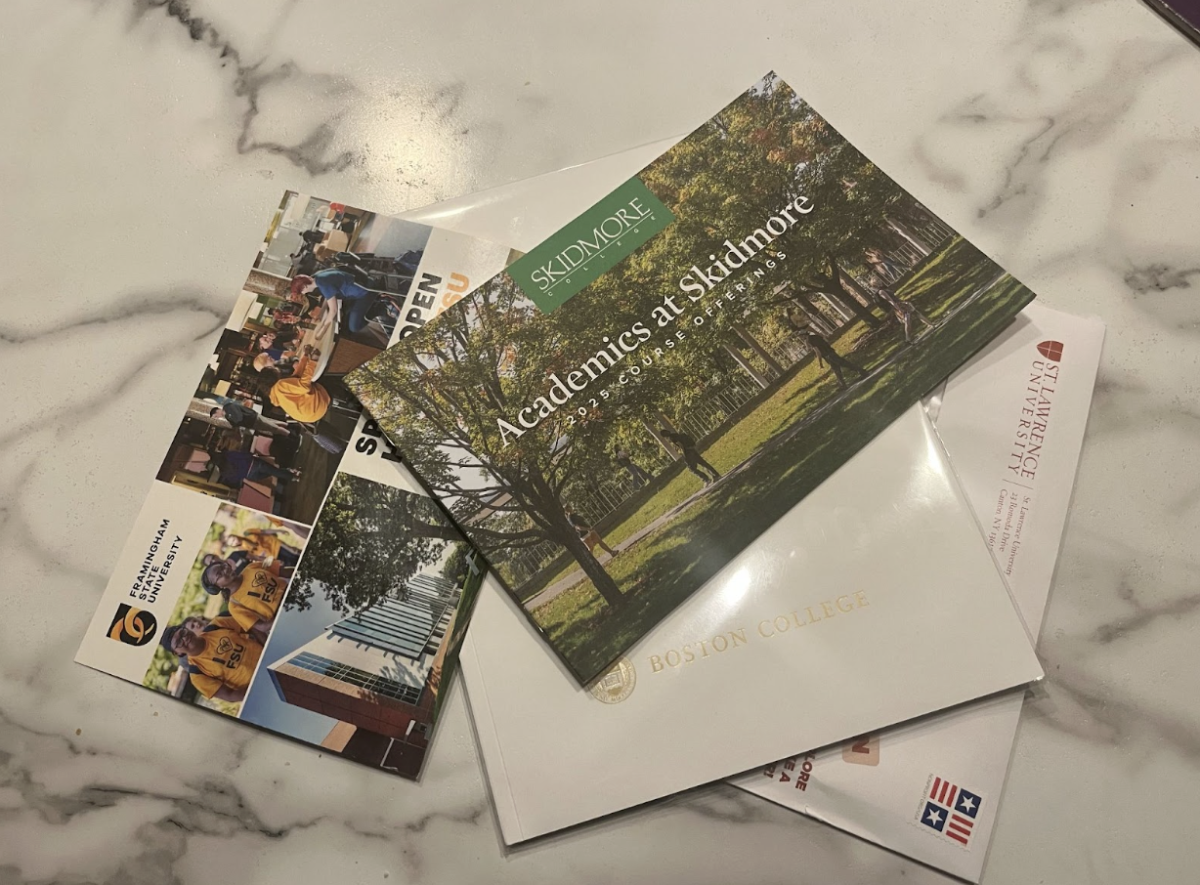
Another way to get a lot of information is to get on a college mailing or email list. This causes the college to send many letters or emails with crucial information about campus life and academics. A quick internet search can get results on how to get college information through mail or emails, because it varies depending on the school. Sometimes, doing something as small as signing up for a tour can cause a person to continue to get emails from a certain college.