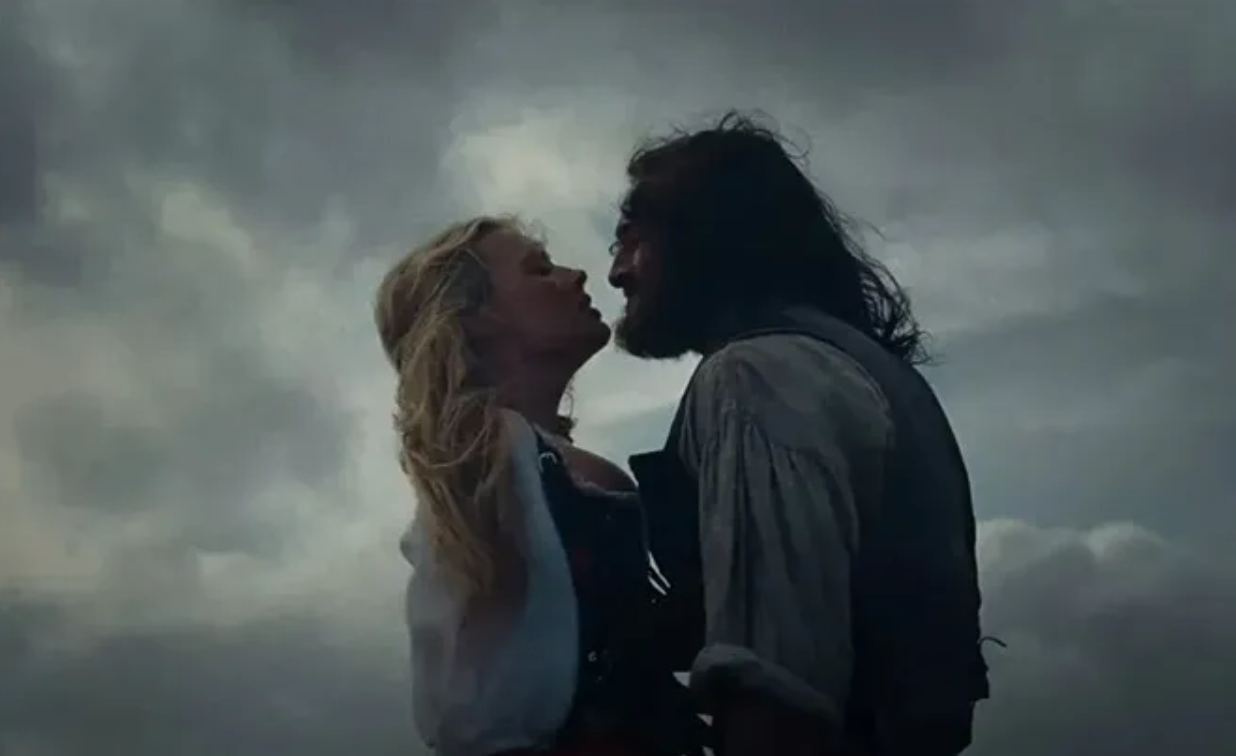




















The tragic gothic romance, Wuthering Heights, written by Emily Brontë and adapted on screen by Emerald Fennell has either left viewers distraught or frustrated. Whether you left the theater in tears because of the utter agony the romance caused you, or you left irritated because the movie lacked the magic that the book created, “Wuthering Heights” managed to encapsulate Cathy (played by Margot Robbie) and Heathcliff’s (played by Jacob Elordi) desire for one another, but their romance lacked depth. The movie was entirely consumed by their cravings for one another, and did not cover the social issues that the novel had not just touched on.
The movie begins with Cathy and Heathcliff as young children, trapped in an abusive household with Earnshaw (Cathy’s father, played by Martine Clunes) who is an alcoholic gambler. You can argue that Cathy and Heathcliff’s relationship with one another was formed because of the trauma they had with one another, and that they were only bonded to each other because of the familiarity and safety they felt with each other. Personally, I do believe that their common trauma does play a role in the development of their relationship, but I also reckon that Cathy and Heathcliff did have true love for one another.
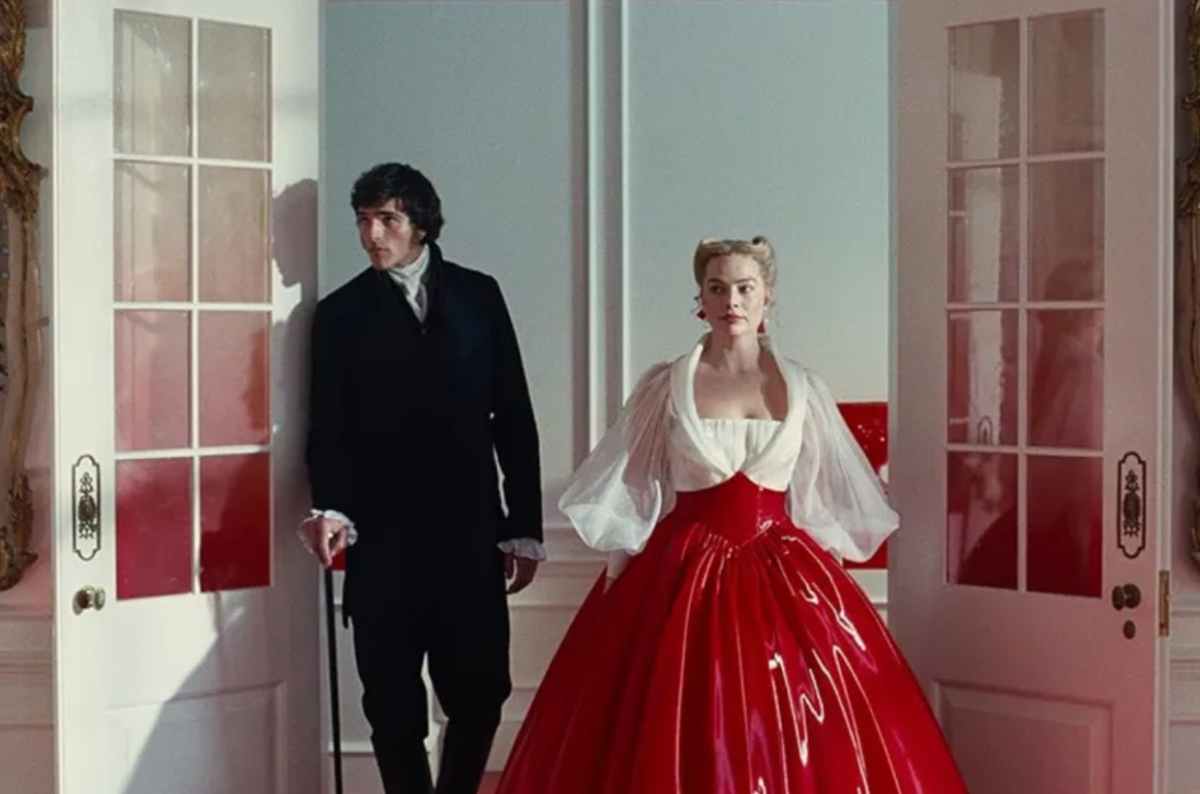
As the movie progresses, so do Cathy and Heathcliff, both realizing their deep love and care for one another, while also realizing that they could never be together. Heathcliff was a servant, even originally portrayed by Cathy’s father as a pet due to his father naming him. Since Cathy and Heathcliff were in different social classes, it would degrade Cathy to wed someone like Heathcliff she claims, even though he is who she burns for. Cathy ends up marrying the neighbor who moved in the house over, an extremely wealthy, kind man named Edgar Linton (played by Shazard Latif). Their marriage is lighthearted, not very heated, and Cathy lacks any real love for Edgar despite his efforts to please Cathy. The marriage is at best comfortable. Cathy becomes bored, depressed, constantly dressed in overwhelmingly dramatic outfits.
We also see how Isabella Linton (played by Alison Oliver) makes a doll of Cathy, further developing the idea that Cathy is an object for the Linton family’s pleasure. She feels entrapped by the house, an environment she’s unfamiliar with after growing up in a filthy home, which slowly consumes and kills her. The skin on the wall which is supposed to be an exact replica of Cathy’s skin, with veins and beauty marks even included, is at first deeply unsettling to the reader. But there’s a deeper meaning behind this skin, this wallpaper represents Cathy becoming one with the house, and she slowly is consumed and becomes one with the house. She is simply this object of beauty for Edgar, an object which he dresses up to show off.
To give some credit to Fennel, the costume choices were on point historically. The idea to dress Cathy in dresses illustrated in famous art works was a detail I personally loved. We see her depicted in the same outfit as “The Girl of Interlaken” painted by Franz Xaver Winterhalter, and many other of her outfits reference famous paintings, further creating this idea of Cathy as this glorified object to Edgar. “The Swing” by Jean-Honoré Fragonard, a painting of depicting a young woman on a swing, kicking her shoe off while a lover watches from below, is also feathered in a scene between Cathy and Isabella Linton and this playful imagery of the painting underlines the initial romantic connection between Heathcliff and Catherine.
Heathcliff returns to the Yorkshire moors of Northern England with a newfound fortune, and immediately seeks out Cathy. Cathy and him resume their intimate relationship with one another, despite Cathy being pregnant with Edgar’s child and married to him. Their love blossoms and grows in the dark, in secret, their passion causing chaos. Edgar forbids Cathy to continue to visit Edgar once Nelly (Cathy was a housekeeper, even considered a lady’s maid, and was played by Hong Chau) reveals to Edgar that Cathy had been having an affair with Heathcliff.
The absence of Heathcliff’s presence causes her heart to break, and she essentially wills herself to die, even though she dies due to a miscarriage and illness. Cathy had created an impossible situation, she would never be able to be with Heathcliff, and metaphorically she brings upon her own demise and uses death to escape her reality. The movie ends with Heathcliff sobbing over Catherine’s cold, dead body.
Although the movie on its own was interesting, its dramatic imagery caught the viewers eye and Margot Robbie and Jacob Elordi had phenomenal chemistry with one another.
Sadie Ferrara, a sophomore at Hingham High School, had never read the book and went into the theater to watch the story of “Wuthering Heights” unfold on screen. Sadie believed that, “The movie was interesting, and honestly a little odd, but I found the romance heart breaking and was upset by the ending and wished that it could have been happier.” Many first time watchers were surprised how gothic this gothic romance was, because often when we hear the word romance we think of a happy ending. But this movie was not that, this movie was disturbing, graphic, and definitely not a “feel good” watch. This movie was meant to make you think, to make you sad, to make you even cry and contemplate what love genuinely is. Yet, the movie lacked that captivating, enchanting feeling that the novel had.
Wuthering Heights, is a renowned gothic romance between Cathy and Heathcliff that is forbidden from the beginning, and ends with the disastrous death of both of them. The novel is excellent, and contains such key details that the movie let out, and these key details are what caused the movie to fall flat.
First, Fennell completely eliminates Hindley Earnshaw (Cathy’s elder brother) from the plot. Hindley resented the close bond between Cathy and Heathcliff, and often was cruel to them both, but this cruelty was simply condensed into Cathy’s father in the movie. The most important, and even shocking detail that was left out of the movie was the matter of Heathcliff’s race. Jacob Elordi did a sensational job as Heathcliff, yet he is not black like Heathcliff was. In the novel, Heathcliff’s race plays such a magnificent role in the plot of Wuthering Heights and the movie cut out this major theme explored in the novel. Heathcliff is mistreated (he is many times referred to as it instead of he by characters in the novel, furthering his dehumanization because he is not white) and excluded by society due to him having darker skin, and this ill treatment is what causes him to act cruel to others later on in the novel. One of the main reasons that Cathy and Heathcliff can not be with one another, besides his economic standing, is that he has darker skin while Cathy is fairer skinned. Unlike the movie, the novel explores the idea of interracial relationships and how race does not play a role in love, and how anyone, no matter their skin tone, can fall in love.
Despite the differences in the movie and novel, by separating the novel from the movie, the movie truly does shine. It is hard to disagree with the fact that the acting in the movie was impeccable, it seemed real, raw, and it truly encapsulates the viewer into the story. The love story is there, it’s gory, tragic, and real– “Wuthering Heights” is a gothic romance that will make the viewers stomach twist, but still move a watcher to tears.
Grace Mahoney is a sophomore at Hingham High and she is going to see the adaptation on March 7, 2026, and she exclaims, “I’m actually really excited to watch “Wuthering Heights” because I have seen such good teasers of the film!” “Wuthering Heights” definitely had a great advertising team as well and the theaters were jam packed when the movie first released, and even though viewers have had different opinions on the film the movie made a good amount of profit, so it only makes sense that the movie was successful on a certain level.
Emily Brontë’s Wuthering Heights is a difficult novel to bring to life on screen, and although key details seem to be missing in Fennell’s recreation that I would have liked to see, the movie is overall worth a watch. The setting is beautiful, the costumes are elegant, and the romance depicted on the scene bewitches the watcher in a state where they can not turn their head from the scene. I highly recommend going to the theaters to get the chance to watch “Wuthering Heights” and judge the movie for yourself. This will not be a love story that takes place in a fairytale world, because in reality, no true love story ever does, and that’s the theme we can see in both the movie and the novel.