




























Everybody listens to music. For some, it’s just background ambience. For others, it’s a hobby. And for a few, it’s a lifestyle. For Alfred Lion and Francis Wolff, it was their livelihood; however, they weren’t musicians.
Lion and Wolff grew up in Berlin in the 1920s and 30s listening to jazz. As Hitler came to power, the two men immigrated to New York in 1937, a wise decision, as both of them were Jewish. Lion rented a studio and established Blue Note Records in 1939, himself serving as producer and Wolff as a photographer. They soon gained a reputation for treating their musicians with respect and hospitality, offering them refreshments and other amenities during sessions.
The label initially focused on “hot jazz” coming out of New Orleans, signing artists like Sidney Bechet and scoring major hits.
As the 1940s rolled in and bebop started to form, the label shifted its focus to this more modern style, recording seminal dates for legends like Thelonious Monk and Bud Powell and cementing itself as a major American record label.
By the start of the 1950s, Blue Note was attracting newer artists like Art Blakey and Horace Silver, nurturing the foundation of a new style of jazz called “hard bop”. As the decade progressed, so did the style. Soon enough, Blue Note and hard bop went hand in hand.
As one of the most popular styles of jazz in the 50s, the development of hard bop propelled Blue Note to new heights, becoming one of the most celebrated record labels at the time – producing hits like Art Blakey’s Moanin’.
The mid-1950s to mid-1960s were Blue Note’s golden age, producing hundreds of records of some of the most popular and celebrated jazz artists of all time, including Miles Davis and Herbie Hancock.
But what made these records so special? Well, to answer that means to look further than just the music. Although the music itself was of unrivaled quality, the recording by sound engineer Rudy Van Gelder captured every sound so perfectly that these recordings sound like they could have been performed yesterday.
Van Gelder ran a home studio in Hackensack, New Jersey, working closely with Blue Note throughout the 50s and 60s. His recording genius led to what critics refer to as the Blue Note sound. Although each Blue Note record is different, they all have one thing in common: The sound quality.
“When I first heard it, I thought it was maybe recorded in the 80s or 90s, but I was super surprised to find out that it was from the 50s. It didn’t sound that old at all,” remarked HHS student Will Monti after hearing a clip of Art Blakey’s Moanin for the first time.
Some say Van Gelder was the greatest sound engineer ever, considering the primitive recording technology of the time, and that is reflected in all of his Blue Note sessions, perfectly capturing the moment and adding to the magic of recorded jazz, simulating a live performance as closely as possible.
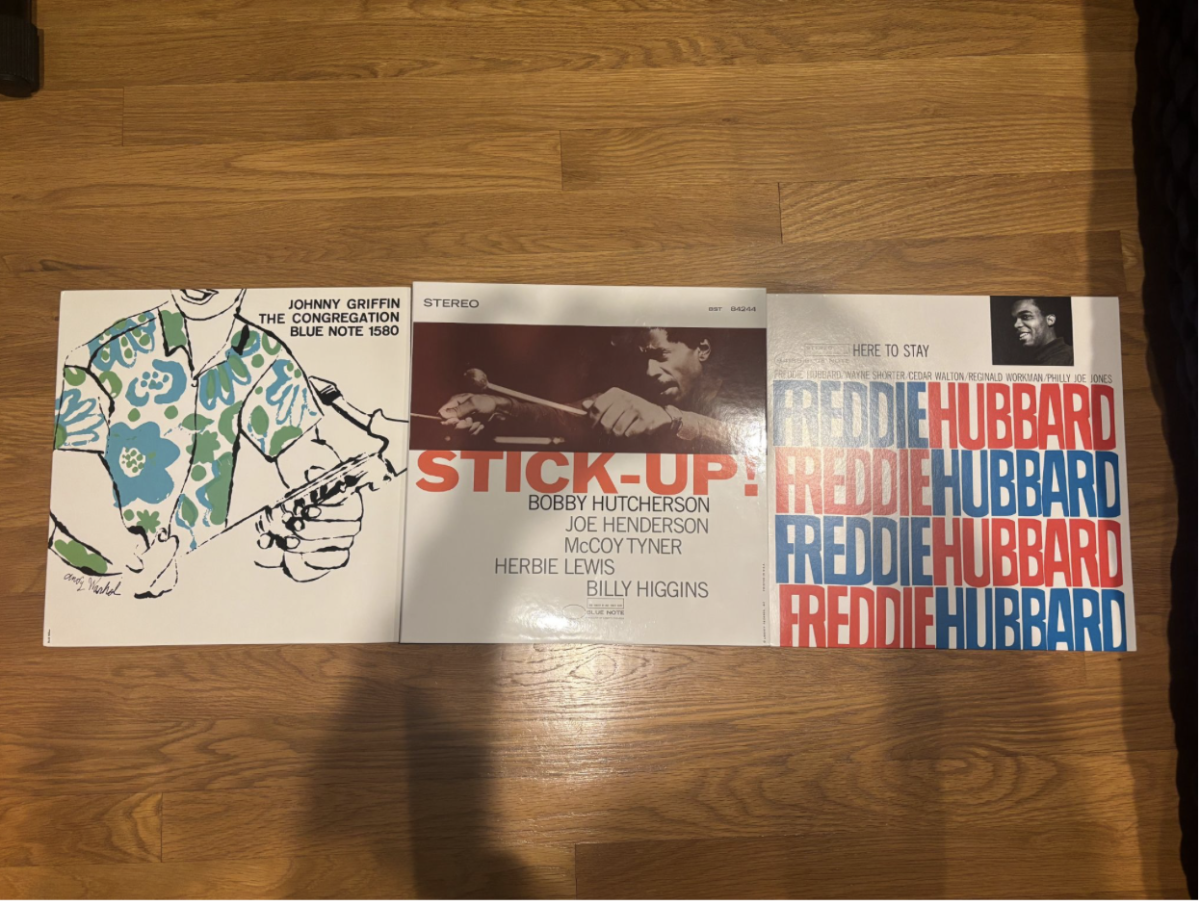
Additionally, Blue Note’s visually appealing album covers were instrumental in selling records and maintaining their relevance over the years.
In a record store, the first impression anyone gets of an album is from the cover. Blue Note’s covers, most of which were designed by Reid Miles, were an art form in and of themselves. Miles utilized carefully placed typography, abstract colors, and photographs of the musicians taken by Francis Wolff.
“I’ve never really seen album covers like these. They’re all super unique, and even though I don’t really listen to jazz, they make me want to give the albums a try,” says HHS student Ava Halsing.
Some of these covers are almost shocking in nature as each one reflects the mood of the album to a T. This visual aspect added another dimension to Blue Note’s aesthetic, leading to even more records sold.
And finally, the music itself. Some say that Blue Note represents the epitome of jazz from all eras. It has become the most iconic jazz label due to the volume and quality of releases from the most relevant artists – John Coltrane, Miles Davis, Herbie Hancock, etc.
As jazz kept evolving, so did Blue Note, embracing new styles like avant-garde and fusion. Although these releases didn’t sell as many records, they reflect the character of the company and the men running it, living up to its slogan as “the finest in jazz since 1939.”
It has continued living up to that legacy by continuing to produce innovative modern jazz from some of the most brilliant minds of our time.
Even though Alfred Lion and Francis Wolff weren’t musicians, they were some of the greatest artists in American history, helping jazz find its identity and providing it with a medium for the listener.
Jazz is sometimes referred to as American classical music, which could not be more true. Jazz isn’t always perfect; it isn’t always pretty, but it always encourages collaboration, togetherness, creativity, and innovation.
It’s fitting that the two men responsible for the creation of the most iconic jazz label lived the American dream themselves, because the art form that they helped define became one of the most important art movements in American culture. Even though it has gradually fallen out of the mainstream, jazz will always be here to stay thanks to those like Alfred Lion and Francis Wolff.