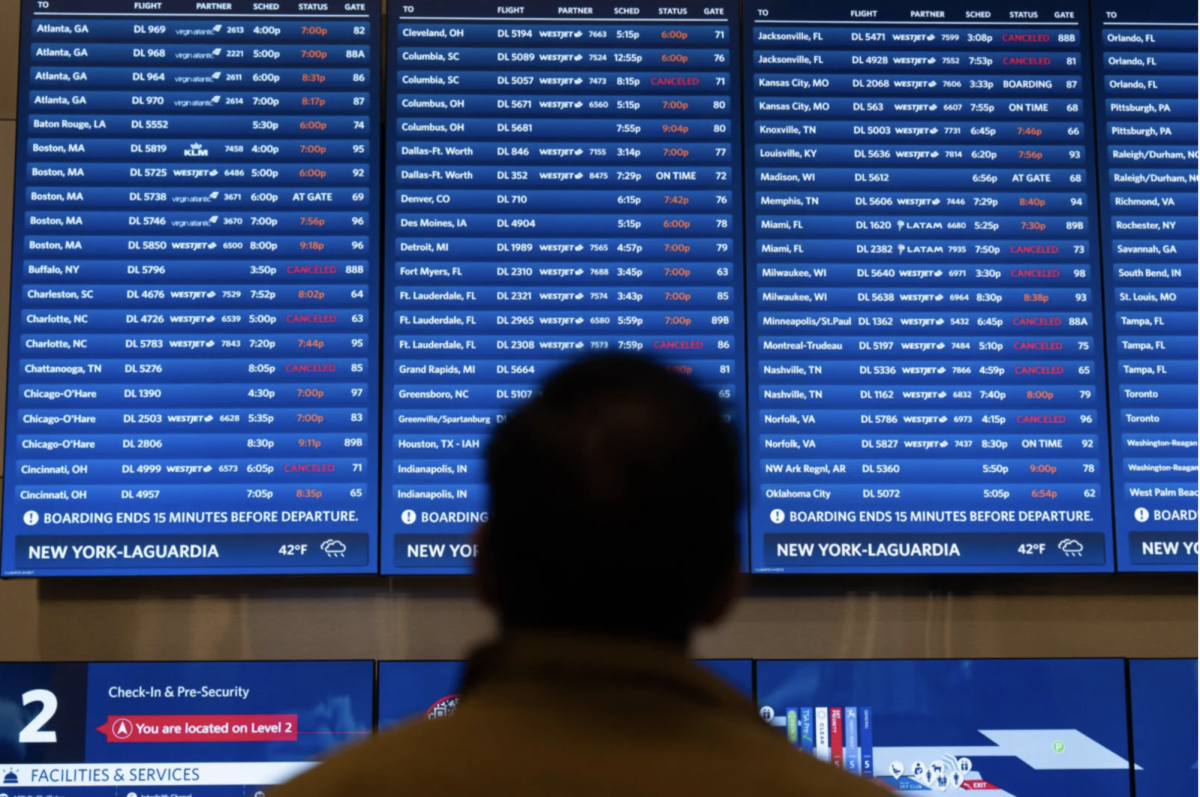























On Friday, November 13, 2026, around 3,500 scheduled departures were forced to remain on the ground and delayed for over four hours due to the Federal Aviation Administration’s (FAA) issuance of a nationwide ground stop. The rarity of the matter and inconvenience for travelers are causing citizens across the country to question the efficiency of air traffic control, with some calling for a more effective system that can ensure consistent communication.
It is important to note that the recent stop served as the third time in the history of modern aviation that the FAA issued a nationwide ground stop, with the first time being on September 11th, 2001, following the devastating terrorist attacks on the United States, resulting in the airspace shutting down for two days. On January 11th, 2023, flights were grounded for around ninety minutes after a failure in the FAA’s Notice to Air Missions (NOTAM) system. With the recent grounding, the FAA explained that American safety is their “top priority” and that it was “out of an abundance of caution,” (FAA.gov), with no further public explanation.
The unclear response has sparked debate across the country, with various opinions over the air traffic control and radar systems emerging. When asked about the efficiency of traveling, Junior Lucca Arata explained, “It feels like almost every time I travel there is some sort of delay, and there never seems to be a clear reason as to why. I understand that air traffic communications is a difficult job, but I believe it is time to find a solution for the problem.”
The urgency of the matter depends on who you ask. For some, traveling is a relaxing experience and does not include a stressful airport trip. Others argue that tight time frames are often missed due to continuous delays, and that the unreliability of it all is unacceptable. Junior Kwaku Oppong noted, “It feels like a gamble every time my family and I are at the airport. I think a solid solution begins with modernizing air-traffic control. It’s a necessary investment our country needs to make.”
President Donald Trump has left the blame on former President Joe Biden for leaving an “old and broken system,” (Newsweek). Trump claims to be pushing Congress to invest substantial amounts of money into the FAA as part of a long-term funding upgrade. Democrats responded by arguing that previous attempts to increase FAA funding resulted in unspent money and that the Republican oversight is at fault, highlighting a clear political division sprouting from this unclear groundstop.
In a society built on rapid modernization, it is clear that the field of aviation is resulting in significant debate and mixed opinions. The recent nationwide ground stop serves as a prime example of outdated infrastructure that the FAA and government need to collectively improve for the betterment of our nation.