



















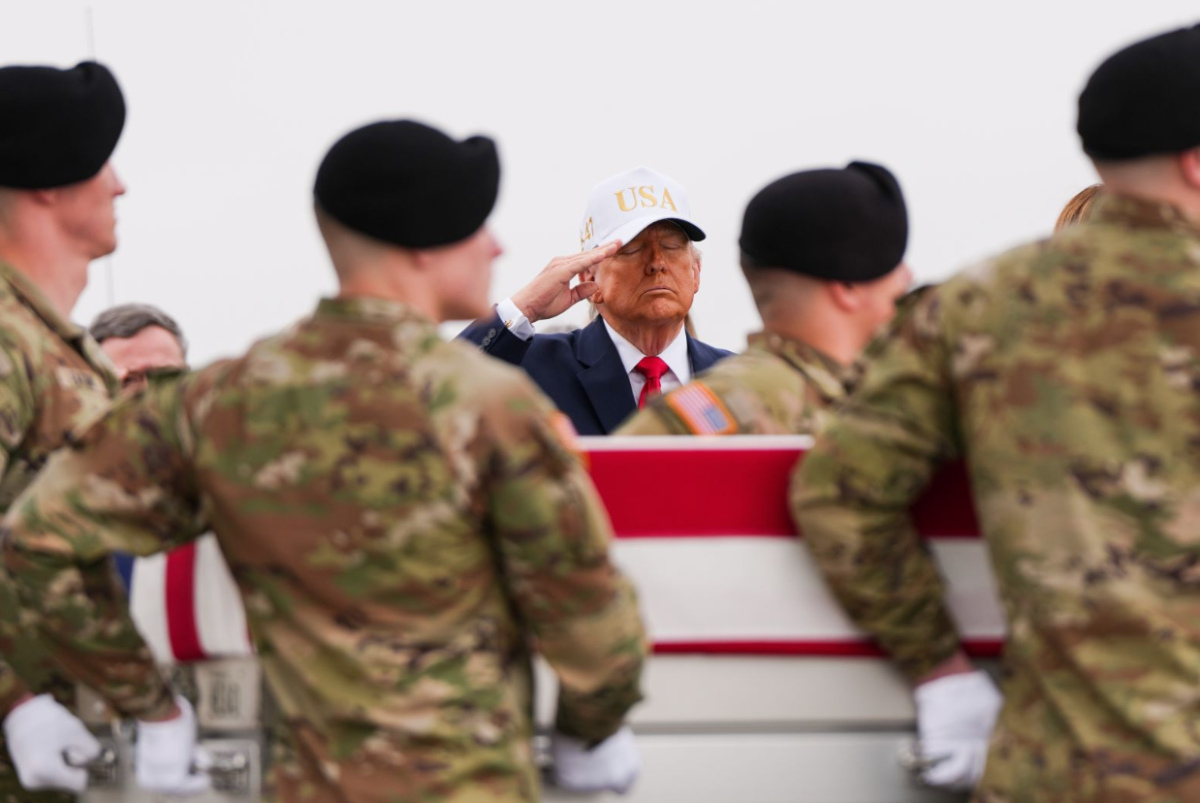
As the war with Iran rages to its third week, President Donald Trump and White House press secretary Karoline Leavitt have released statements in which they did not directly deny the possibility of a future draft. Despite the US government emphasizing its current focus on mainly an air dominated war, the refusal to deny the possibility of a future draft has provoked a national debate. This has led to mixed feelings from teens, some scared that in the coming years, they will be sent to war rather than starting their lives, attending college, or getting a full time job.
Junior Teddy Lambert said, “Junior year is already the most stressful year in high school. The last thing I need is ending up in the Middle East fighting instead of going to college. Although there has not been an official declaration of a draft for the war with Iran, students should be aware of the possibility and process if one does occur.”
Throughout United States history, the government has used the draft in the Civil War, World War I, and World War II. Additionally, over 50 years ago, the U.S. used the draft for the final time during the Vietnam War, with the final draft call on December 7, 1972. The war looms over American’s heads in everyday life due to rising gas prices. The suspense of the war has built up pressure within the American body and engendered the idea of the draft being put back into effect.
The actual possibility of a draft is pretty unlikely because the United States has participated in numerous wars without using a draft, including the wars with Iraq and Afghanistan. This is a promising sign that the government may not need to put the draft into place unless the war with Iran expands greatly.
Although the United States of America has not used and not needed to begin a draft in recent decades, there is a program in which all young men living in the United States must register. The Selective Service System is an independent U.S. federal agency, in which men living in the United States, whether a citizen or immigrant, and from the ages of 18 to 26 are required to register with. This helps the U.S. government keep a database for the possibility of needing to use a draft in the future. As for women, they are not required to register, however they are open to expanding the registration.
Sophomore Ava Halsing mentioned in an interview, “I find it really interesting that here is the possibility of women being included in a draft. The last war with a draft was when women didn’t have many rights, so it could be a historical change if the war with Iran grows.”
In an interview on Fox News on March 8, Karoline Leavitt was asked about the potential of sending troops to the country of Iran to fight on land, rather than just in the air. “Mothers out there are worried that we’re gonna have a draft, that they’re going to see their sons and daughters get involved in this,” Maria Bartiromo said during the interview.
Leavitt responded, “The president as commander-in-chief wants to continue to assess the success of this military operation. It’s not part of the current plan right now, but the president, again, wisely keeps his options on the table.” Her statement has pushed people to believe that President Trump is keeping “his options on the table” to do whatever he can to win the war with Iran, even if that means starting a future draft.
In the case that a draft is seriously considered, the president may not put this into place on his own; Congress must pass legislation to amend the Military Selective Service Act to reinstate the draft. According to the Selective Service, the draft, if put into place, would be conducted similarly to that of the Vietnam War. The Selective Service would be expected to hold a draft lottery based upon the date of birth for each man. Numbers would be given to certain dates, for example 4 might correspond to February 1. Officials would then draw numbers similar to a lottery; if your birthdate is selected first, you would be the first to be drafted. The Selective Service claims that, if the draft happened today, those who are turning or already 20 during the year in which the numbers are drawn, would be the first to be drafted. As soon as the men turn 21, they are dropped to the lower priority group while the men born a year after them would be elevated to group one, the priority group. Until they reach their 26th birthday, the men drop into the next lower priority group.
It is significant to mention that despite someone registering with the Selective Service System, they may not be automatically placed into the military. They must pass physical and mental examinations to see if they are fit enough for the harsh conditions of war. Some may be eligible for deferment including married persons, or college students. One may be excluded for physiological or medical reasons, or they may declare themselves to be a conscientious objector, meaning if a person has a deeply held religious, moral, or ethical beliefs against war, they may not have to be drafted to the front lines. Instead, they would likely be assigned to a different position, like medical, to help support the war.
As the threat of a draft remains relatively low, people living in the United States should pay attention to the possible growth of the war with Iran to understand the impact and process of a future draft.