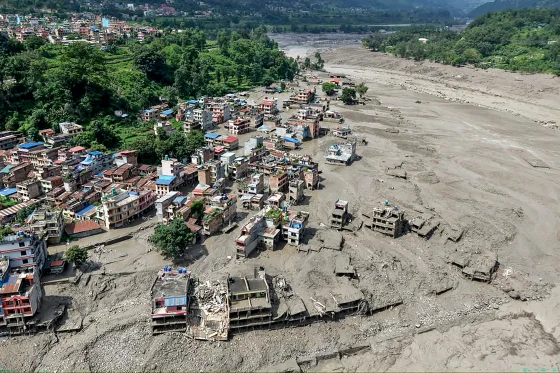



























On the morning of August 26, 2026, a terrifying wall of water, mud and rock tore through northern Nepal, transforming a Himalayan valley into a disaster zone within minutes. The flash flood struck along the Nepal-Tibet border, particularly the Rasuwa district, sweeping away homes, roads, bridges and critical infrastructure and leaving hundreds of people unaccounted for.
What makes the disaster especially horrifying is how suddenly it unfolded. A huge mass of ice, rock and debris appears to have surged into the river system upstream, producing an enormous pulse of water that raced downstream through the Bhote Koshi and Trishuli river systems. Scientists are investigating whether a glacier collapse or ice-rock avalanche, potentially influenced by a recent earthquake and unusually high temperatures, triggered the event. The precise chain of events is still being established.
The destruction was immense. By Wednesday, Nepalese authorities had confirmed at least 95 deaths, while hundreds remained missing. Reports also indicated that more than 400 people—including hundreds of foreign nationals—were unaccounted for. Many were travelers and pilgrims passing through the region, including people heading toward Mount Kailash in Tibet. When told about the striking results of the floods, Hingham High School senior Kaylie Fabrizio noted that “It is devastating to hear about this. Nepal has already had enough economic stress, and now they have had a catastrophe.”
Communities along the river had little time to react. Buildings were swallowed by rushing water and debris, vehicles were swept away, and roads and bridges that connect remote Himalayan settlements were destroyed. Hydropower facilities were also damaged, threatening electricity supplies and complicating an already difficult rescue operation.
Across the border in China’s Tibet region, the disaster was equally devastating. A mudslide struck the Gyirong area, damaging roads and infrastructure and leaving hundreds missing. Chinese authorities reported additional deaths, underscoring that this was not simply a localized flood but a catastrophe spanning the rugged Himalayan frontier.
Rescuers now face one of the most challenging environments imaginable: steep mountains, destroyed roads, unstable slopes and swollen rivers. Helicopters have been deployed, but reports indicate that reaching some affected areas has been difficult. Nepal’s army, police and other emergency personnel are searching for survivors while authorities struggle to determine the full scale of the destruction.
Beyond the immediate tragedy lies a larger warning. Nepal sits at the heart of a rapidly changing Himalayan environment, where glaciers are retreating and high-altitude hazards can threaten communities far downstream. Experts say rising temperatures can contribute to glacier instability, potentially increasing the danger from sudden ice, rock and water releases. When asked about climate change impacts, Hingham High School senior Tatum Lane said, “Honestly, I had no idea that among the other impacts of climate change, the rise in global temperatures could lead to the melting of glaciers and could ultimately result in mass floods.”
For now, however, statistics cannot capture the human cost. Families are waiting for news. Rescue workers are searching through debris. Travelers remain stranded or missing. And along rivers that moments earlier seemed ordinary, entire stretches of community life have been erased.
The Nepal flash flood is a striking reminder of nature’s extraordinary power—and of how quickly a peaceful Himalayan morning can become a fight for survival. As rescue teams continue their desperate work, the world waits to learn just how high the final toll will be.