




















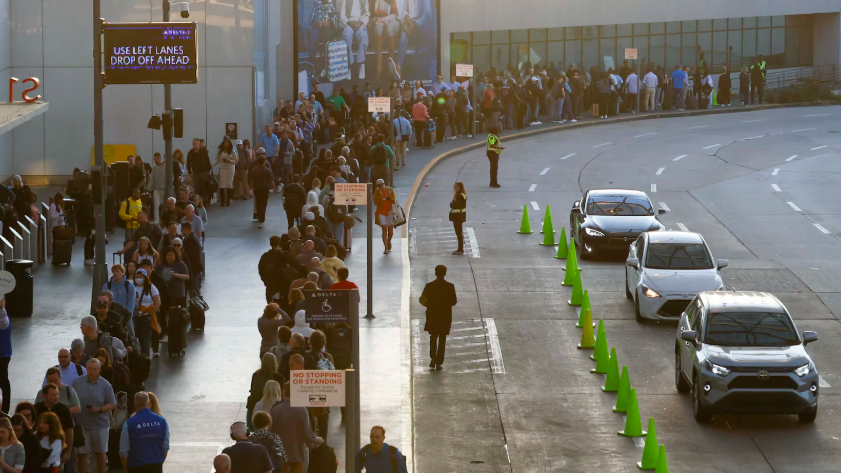
Early in the mornings and long before most Americans have risen from their beds to begin their workdays, security lines at airports all around the country have already been snaking around corners, out airport entrances, and in some cases, even into major highways. But what is the cause for this national occurrence? And how should Americans who plan on using air transportation navigate it?
For the last forty days, the United States Congress has been scrambling to remedy a partial government shutdown prompted by an inability of representatives to come to a clear consensus on a bill that would fund the Department of Homeland Security (DHS). Although most Americans primarily associate DHS with Immigrations and Customs Enforcement (ICE) given the recent ICE crackdowns and increase in mass deportations, the department is actually responsible for a plethora of other government agencies such as TSA, cybersecurity, and FEMA.
Without proper funding to DHS, none of these agencies can efficiently perform their designated tasks, which poses an inconvenience to those passing through airports as TSA workers who aren’t receiving any pay for their work have little incentive or reasoning to show up for their jobs.
Unfortunately for travelers, President Trump and his republican allies have been seemingly unwilling to bend to Democratic petitions and proposed bills to end the shutdown. One of the Democrat’s major requirements to pass a bill is to cut down on funding for ICE and to avoid passing the SAVE America Act (Trump’s proposed bill to amend voter registration to provide for proof of citizenship before voting). Unwavering, the President stated to Oval Office reporters on Tuesday morning that “Any deal they make I’m pretty much not happy.”
Airports affected by the government shutdown have been disproportionately affected across the country. On Saturday, over 3,400 TSA employees called out of work and over 400 have quit. In response, Trump has deployed ICE agents to affected airports to oversee the security processes which has prompted varied responses and results.
With limited knowledge on how long the DHS shutdown will presumably last, Americans preparing for their flights should know how to prepare for significantly longer wait times and where they are most likely to encounter airport trouble. Presently, William P. Hobby and George Bush Intercontinental airport in Houston TX have the highest call-out rates followed by Hartsfield-Jackson Atlanta International Airport (ATL), and John F. Kennedy International Airport (JFK) in New York. These airports, all reporting more than four hour wait times for security lines, are advising travelers to plan their travel days accordingly to ensure they don’t miss their flights.
Locally, Logan Airport out of Boston has been less affected by the DHS shutdown and presently, there is no ICE presence aiding with security lines. However, as spring break approaches Boston travelers should stay informed about how their flights may be impacted. In fact, many HHS students are worried about how their plans may be affected – Junior Grace Moore stated that “I am worried that if the shutdown lasts until April break, that Logan airport might get bad wait times as well.”
Until the shutdown ends, travelers should remember to get to the airport at least three hours early, check in online, and have items like a passport at the ready. Junior Megan Buckley agrees stating that “I am planning on arriving super early because I can’t risk missing my flight.”
While next steps remain unconfirmed, travelers should take into account this information to ensure a safe and enjoyable spring break.