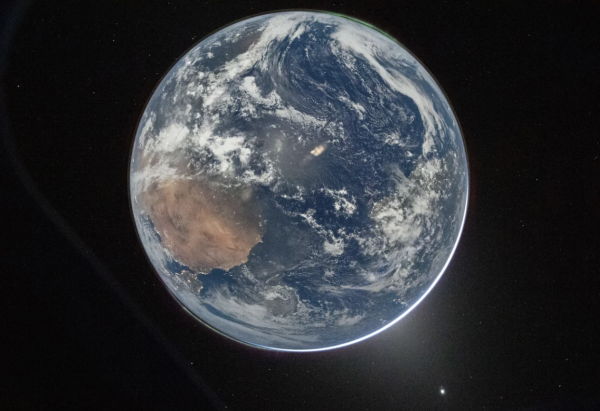




























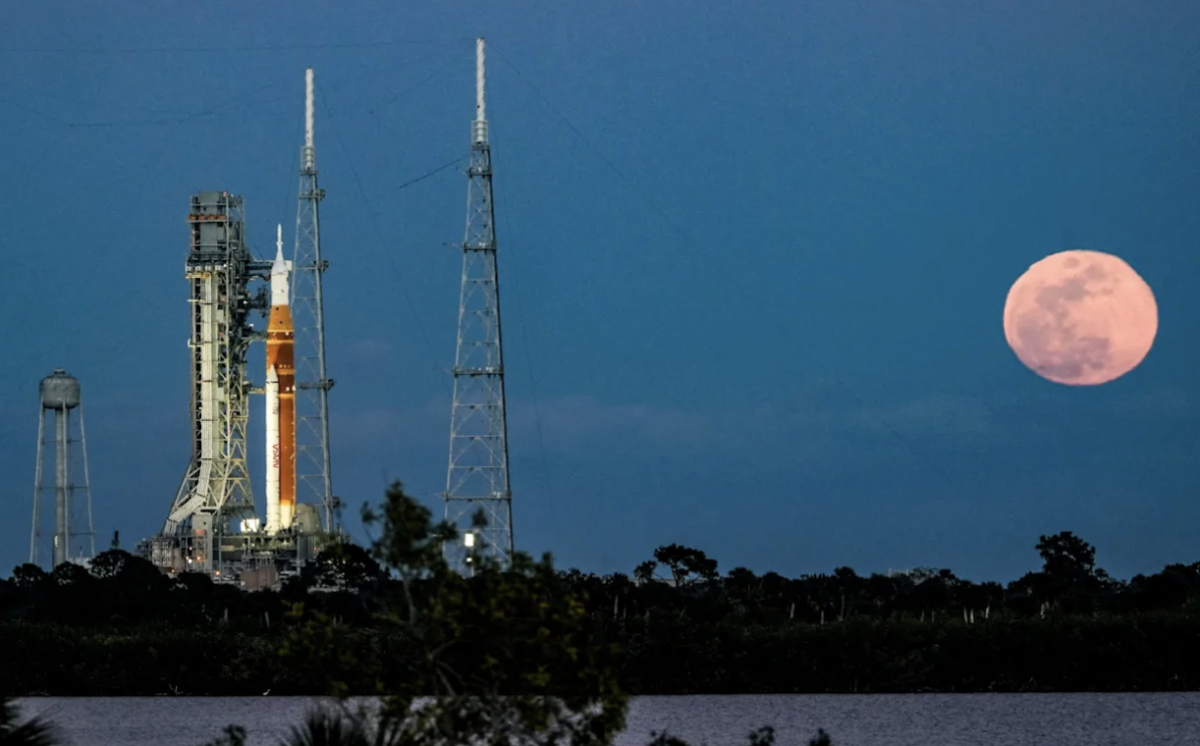
On Wednesday, April 1, millions of spectators worldwide watched as Artemis II launched from Kennedy Space Center in Florida. For the first time since 1972, humans were headed toward the Moon, taking a major step in the development of modern space exploration.
Junior physics student Micheal Blackwood watched the take-off from NASA’s livestream, commenting, “It was incredible to see something so historic as it happened.”
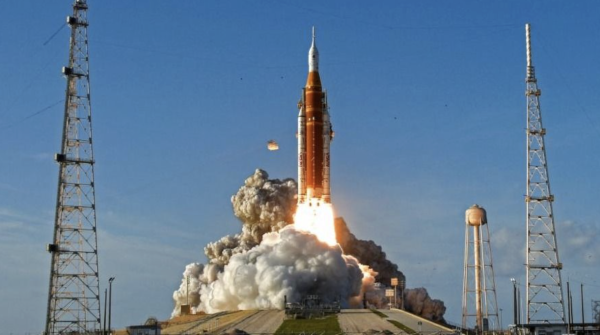
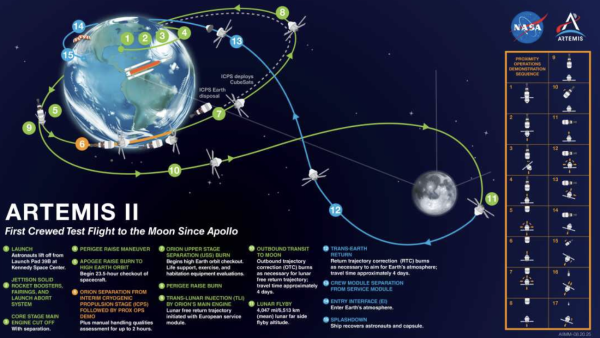
Over ten days, the crew of Artemis II will test new life-support systems, spacecraft performance, and deep-space operations. Though the spaceflight will not land on the moon, it will make history in other ways, as humans reach the furthest distance beyond Earth (252,800 miles) and their highest-ever velocity (25,000 mph).
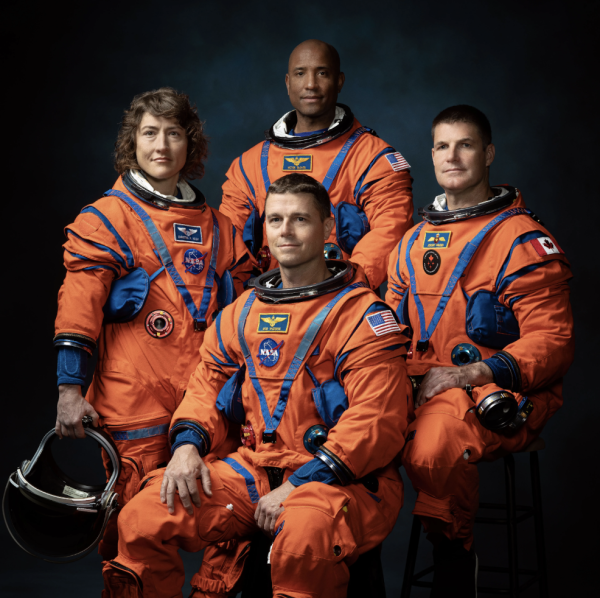
Four astronauts crew this record-breaking mission: Reid Wiseman, Victor Glover, Christina Koch, and Jeremy Hansen.
Commander Reid Wiseman was born and raised in Baltimore, Maryland, and graduated with a Master of Science in Systems Engineering from the nearby Johns Hopkins University. He continued on to be a 27-year Navy veteran, selected as an astronaut in 2009. Wiseman has already logged 165 days in space aboard the International Space Station. On Earth, he is a single father of two girls.
Pilot Victor Glover was born in Pomona, California, and received his highest education at the Naval Postgraduate School, also with a Master of Science in Systems Engineering. After earning his wings of gold in 2001, Glover rose to be a test pilot, until pivoting to Georgetown University, where he completed a Certificate in Legislative Studies and interned in the Senate. Finally, in 2013, he was selected to be an astronaut, gaining experience aboard previous SpaceX missions. Glover will now be the first person of color on a lunar mission.
Mission Specialist Christina Koch is a native of Grand Rapids, Michigan, with a passion for the area’s surrounding outdoor hobbies. She graduated with a Master of Science in electrical engineering from North Carolina State University. She then applied her knowledge as an engineer for NASA, and also as a researcher in Arctic stations. Finally, she was selected as an astronaut in 2013. Already having set a record for longest single spaceflight by a woman (328 days in 2019), Koch will now be the first woman on a lunar mission.
Mission Specialist Jeremy Hansen represents the first non-American to travel to the moon, having been raised in Ontario, Canada. After receiving his pilot’s license at just 17, Hansen then graduated from the Royal Military College of Canada with a bachelor’s in space science. He went on to work as a test pilot, voice mission control for the International Space Station, and participate in extreme space simulations until his selection for Artemis II.
Artemis II is essentially a test flight for NASA’s latest engineering projects: the Space Launch System (SLS) and Orion spacecraft. The SLS is the most powerful platform NASA has ever built, designed to push humans further into space than any predecessor. Sitting atop it is the Orion capsule, packed with advanced life-support systems, deep-space navigation tools, and a heat shield designed for the fastest-ever reentry speed. Proving the functionality of these systems sets up NASA for later and greater space exploration.
April 1st was not the intended time for takeoff. The original, unmanned mission of Artemis I found weaknesses in NASA’s designs, requiring extensive testing and redesign. Other discovered issues, even after the rocket had been rolled out to the launch pad, only furthered delays. While frustrating to the public, the safety of the mission is non-negotiable, especially for the first deep-space mission in 50 years.
Why now return to the moon? Strategically, the United States is competing for the forefront of space exploration, as commercial companies and international competitors expand their capabilities. Scientists are also eager to study lunar water, which could be used for long-term habitation and additional testing, with far-off dreams for Mars.
When told of these plans, Hingham high schooler Leo Eilson remarked, “It is crazy to think a moon base and landing on Mars is a part of NASA’s actual timeline in our lifetime.”
After the completion of Artemis II comes Artemis III, planned to be the first lunar landing of the 21st century.
Artemis II is simply another step for man towards the stars, as NASA heads a new era of exploration while inspiring millions of people in its pursuit.